

Fifth Sunday of Lent — March 22, 2026
The raising of Lazarus from the dead is surely one of the great passages in the New Testament. Jesus comes to the cave-tomb where Lazarus is buried and summons his friend to "come out!" Still bound in his burial clothes, Lazarus appears, alive and walking.
What exactly happens? First, we must understand that Lazarus does indeed die; he is not 'playing dead' in the tomb. His body is lifeless and decaying. What Jesus does is to revoke that corporeal state of death. He restores Lazarus to his earthly life – but he is not in a heavenly body. He must die again later, for it is not given to any person to spend eternity on earth in an earthly body. If that were not so, then Lazarus would still be walking around somewhere east of Jerusalem.
Jesus raises Lazarus from the dead as proof that He can reverse Adam's curse, that He can "open graves and raise (us) from them" (Ez 37:12). We should be struck by the utter simplicity of this miracle. No hands-on resuscitation – just a few words! It is the same when He raises the daughter of Jairus and the son of the widow of Nain. As St. Braulio writes: "The power of Jesus is so great that it is easier for Him to raise the dead than it is for us to arouse those who are sleeping."
So, do not be discouraged at the death of a loved one. Remember, Jesus does not see the dead as we see them. The sign of Lazarus is the sign of "Life in fullest measure," for Christ is God of the living, and He will "rescue from death" all who believe in Him.
— GM
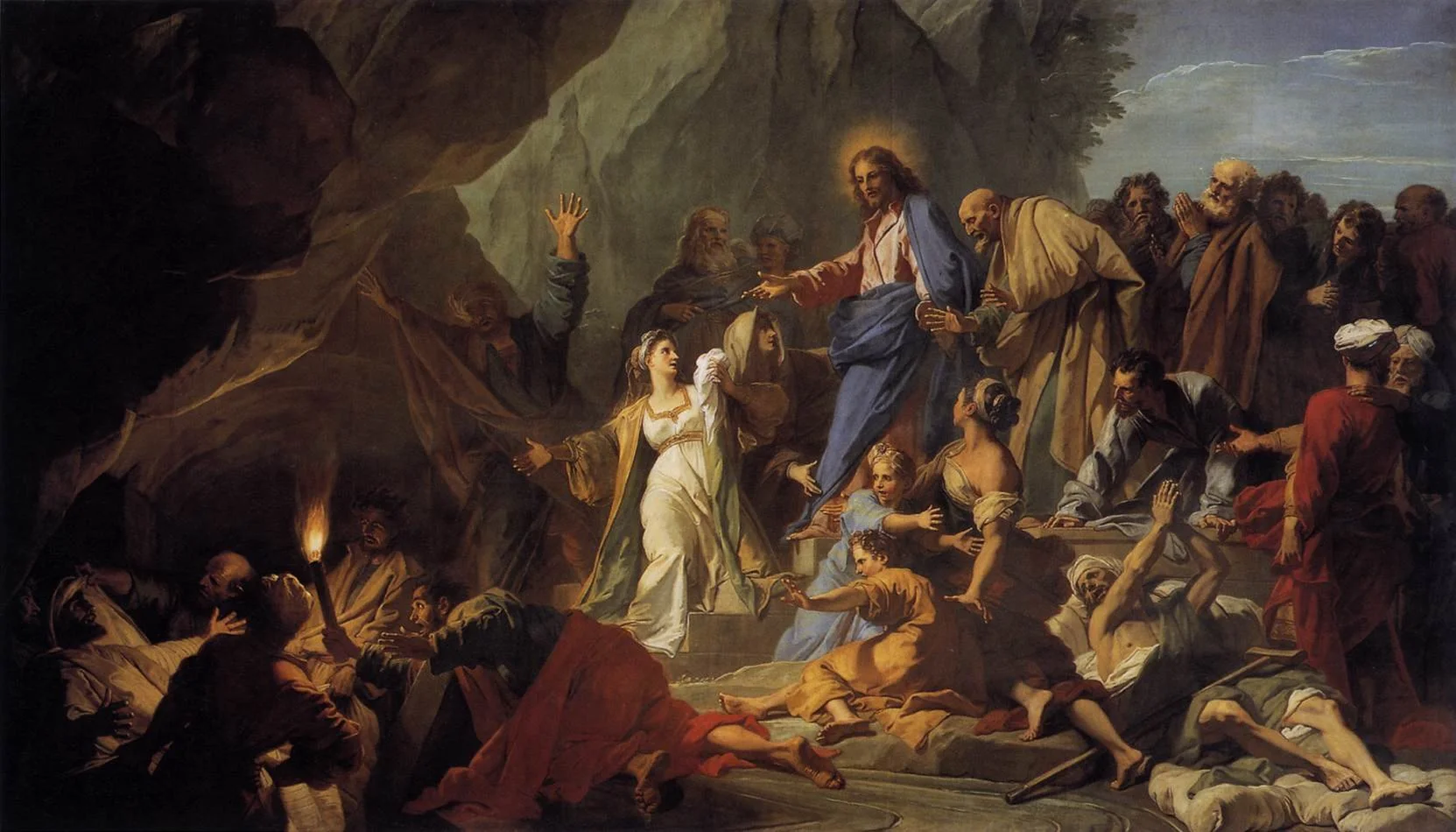
Jean Jouvenet, The Raising of Lazarus – public domain (17th‑century French Baroque painting)